La Basse Cour: B&B near Alencon, Normandy
Motorbikes Welcome at our Biker Friendly B&B
Biker - Friendly B&B on Normandy-Loire border, France


We Welcome Motorbikes, Bikers and Motorists alike at our Bed & Breakfast
We have welcomed bikers at "La Basse Cour" ever since we first opened our doors in 2005 - and not just for MotoGP and 24 Hour Moto weekends. Normandy and Pays de la Loire, like much of France, have mile upon mile of deserted, winding backroads which are a dream for bikers and motorists longing to escape overcrowded roads.


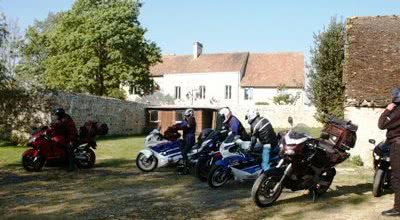


Access from the main road is via an unmetalled driveway - it is hard-packed and solid. The main parking area in front of the barn has a stone chipping surface. Easy to ride on, but in some parts it's wise to use a weight spreader (ask us for one if necessary) before leaning heavy bikes on side stands.
The small barn is past and the house to the left. Inside the small barn there is a solid floor.
There is an airer in the barn for drying wet weather gear. Cloths and detergent can be provided for cleaning helmets and visors.
If you don't want to clutter your room with helmets and gloves etc. then you can leave them in the entrance hall; there's no need to take biking boots off in the house.
Driving in France / Riding in France
Information on
Road conditions and radar speed traps in France
Rules and regulations for motorists in France
Speed limits in France
Roadsigns in France
"Priorité-à-droite"
Fuel
Accidents
French car parts translated
Road Conditions and Speed Traps in France
It was announced in May 2011 that radar warning signs were gradually being removed, but the removal process was halted after a year. The official government site showing positions of fixed radars in France is no longer maintained since that date. In January 2012 it was announced that all radar warning devices are illegal in France, both passive (GPS) and active detectors.
Equipment which detected speed camera radar signals etc. had always been banned in France, but the new laws took matters a step further by banning SatNav warnings, too. The penalty is a fine of up to 1500€ and 6 licence points.
Websites continue to provide positional information for radar traps, both fixed and mobile. For instance, GPS-data-team.com is a user-maintained site for Speed Cameras in France downloadable to GPS. The fixed points are reliable (but there is no guarantee they are complete) but the mobile radar points often cry wolf as they indicate where speed camera patrols are known to operate, but the gendarmes are rarely there in reality. Mobile speed controls by gendarmes are becoming more frequent - if oncoming drivers flash headlights it may mean that gendarmes are stationed ahead of you.
Are there road problems on your route - the Bison Futé site will tell you.
Driving and Riding in France - Rules & Regulations
Download an English language version of some basic rules of Driving in France.
- Drive on the right; obvious, but if used to driving/riding on the left, it is easy to forget at roundabouts, exits from side roads and from car parks/petrol stations (especially stations on the "wrong" side of the road).
Bikers - stick a piece of tape on your right hand mirror as a reminder! - Bikers must have headlights on at all times. From January 2013 hi-viz clothing will be mandatory.
- It is compulsory for car drivers and passengers to wear a seat belt front and rear (if fitted)
- Children up to 10 years of age must travel in rear and wear a seat belt or be strapped into a child seat.
- Mobile phones must not be used while driving except with a "handsfree" kit. Fine 135€ as at January 2012.
- All motorists must carry a reflective jacket within easy reach - this hi-viz jacket is to be worn in case of breakdown or accident when you get out of the car/off your bike. The jacket has to be carried within reach - not the boot. The requirement for reflective jackets in France has applied to motorbike riders since January 1 2016. At time of writing (2016) fines for not having a hi-viz jacket are just 11€ in case of a traffic control, rising to 135€ for not having one in case of an accident. It is NOT a requirement for passengers to have reflective jackets.
- Drivers must carry a reflective triangle in their vehicle to be placed behind the car to warn other motorists in case of accident or breakdown should the vehicle hazard lights not function.
- It is advisable to carry a spare bulb kit and know how to use it - it is NOT a legal requirement to carry spare bulbs in France, but you do risk having your vehicle immobilised or impounded if you are stopped with a faulty bulb and you can't change it on the spot.
- On motorways (autoroutes) it is illegal to drive or park on the hard shoulder except in an emergency. From 2012 straying onto the hard shoulder, even clipping it for an instant, will also be subject to a fine of 135€.
- You must be able to produce your driving licence, car/bike registration document and insurance certificate when asked by the Police, Douaniers (customs officials) or Gendarmes.
- Driving licences issued by other EU countries, e.g. UK licences, are valid in France. Drivers/riders must carry this with them.
- International Driving Licences accompanied by a valid foreign licence (non-EU or EEA) are valid in France for up to one year.
- The minimum age in France to drive a car or ride a motorbike over 80cc is 18.
- The minimum age to ride a scooter or motorbike under 80cc is 16.
- There is NO legal requirement for car drivers to carry a fire extinguisher or first aid kit, whatever the shop assistant at the port or the man on the ferry tells you!
France Speed Limits
Speed limits are as follows unless otherwise signposted:
- Autoroute (freeway/motorway): 130 kph and 110 kph in rain, 50kph when visibility is 50m or less. The MINIMUM speed unless you're in a backed-up line of slow moving traffic is 80kph.
- Autoroute in urban areas: 110 kph and 100 kph in rain, 50kph when visibility is 50m or less.
- Dual carriageways and single lanes separated from oncoming traffic by an island or crash barrier: 110 kph and 100 kph in rain
- Single carriageways outside town/village limits: 80 kph (since 2019)
- Built up areas (towns and villages): 50 kph
- All roads when visibility is less than 50m (e.g. heavy fog): 50 kph
French Road Signs
Download the 160 commonest French road signs (meanings are in French)


Drinking and Driving in France - alcohol limits
It's sometimes suggested that the French are relaxed about drink driving - but the truth is that in general the police operate a policy of zero tolerance towards drink driving.
In 2012 a law came in requiring bikers and car drivers to carry an approved breathalyser (alcotest or ethylotest), unused and in its original wrapping. The theory was that if you'd had a drink then you would test yourself before driving. Some sites advise you that you need two breathalysers (so that you have one unused after if you have used one) but that is not the case as long as you don't use one!
In fact, however, there are no penalties if you don't have an alcohol test on you - the law is not enforced and you won't be arrested, get penalty points or be fined for not having one. That said, if you feel more comfortable having one then they cost just a euro or two in supermarkets, pharmacies and motorist shops. Be aware that breathalysers are date limited - this year's wont be any good next year. A rule of thumb
The best advice is not to drink alcohol at all when driving. However, as a rule of thumb, and in no way to be taken as a recommendation or legal advice, an average (12 stone) man's limit in France is often quoted as two SMALL glasses of the type SERVED IN BARS AND RESTAURANTS AS STANDARD MEASURES. Those served in homes are generally much larger.
Penalties
Between 0.5g and 0.8g of alcohol per litre of blood, you are committing a "violation of the 4th class" with a fine of 135€.
Over 0.8g of alcohol per litre of blood, you will appear in court. The court may order a fine of up to 4500€, two years imprisonment, and a licence suspension up to three years.
Fuel: Petrol and Diesel in France
 Petrol stations sell diesel (gazole or gasoil, usually yellow or black handles) and unleaded petrol in 95 and "Super" 98 octane (essence sans plomb, usually green or blue handles) . Many also stock LPG (GPL in French) and some also stock bioethanol and paraffin. Make sure you know what you're putting in the tank! Pumps marked 24/24 are USUALLY credit card only, requiring a chip-and-pin card.
 Traffic Accidents in France
In the event of an accident call the police (Tel. 17). Both parties must both fill in an accident report form (constat à l'amiable) and exchange insurance details; get a blue constat à l'amiable form from your insurer before you leave, fill in your details before you have an accident and keep it to hand. Take photos if you can at the scene.
Common car parts in French
- Accident form to complete in case of an accident - Constat aimable
- Airbag - Airbag
- Antifreeze - Liquide de refroidissement
- Fog light - Feux de brouillard
- Battery - Batterie
- Bodywork - Carrossage
- Boot - Coffre
- Brake lights - Feux stop
- Brake fluid - Liquide de freins
- Bulb - Ampoule
- Bumper - Pare-choc
- Centralized locking - Fermeture centralisée
- Cruise control - Régulateur de vitesse
- Dashboard - Tableau de bord
- Defroster - Dégivrage
- Demist - Désembuage
- Diesel fuel - Gazole
- Diesel motor - Diesel
- Driver window - Vitre conducteur
- Engine oil - Huile moteur
- Fender - Garde-boue
- Front - Avant
- Fuse box - Boite à fusibles
- Halogène bulb - Ampoule halogène
- Hazard lights - Feux de détresse
- Headrest - Appui-tête
- Headlight - Feu de route or Phare
- Horn - Klaxon
- Indicator - Clignotant
- Insurance certificate - Certificat d'assurance
- Petrol - Essence
- License plate - Plaque d'immatriculation
- Lights - Lumières
- Liquid propane gas - GPL
- Low beams - Feux de croisement
- Oil pressure - Pression d'huile
- Parking lights - Feux de position or Feu de stationnement
- Petrol - Essence
- Power steering liquid - Liquide d'assistance de direction
- Rear - Arrière
- Rear view mirror - Rétroviseur
- Registration card - Certificat d'immatriculation
- Reversing light - Feux de recul
- Seat - Siège
- Seat belt - Ceinture de sécurité
- Sidelight - Feu de position or Feu de stationnement
- Spare wheel - Roue de secours
- Steering wheel - Volant
- Sunvisor - Pare-soleil
- Tank - Réservoir
- Tyre - Pneumatique or Pneu
- Tyre Wall - Flanc extérieur pneu
- Trunk - Coffre
- Valve - Pape
- Ventilation - Aération
- Wing - Garde-boue
- Window - Fenêtre
- Windscreen - Pare-brise
- Windscreen washer liquid - Liquide lave glace
- Windscreen wiper - Balai essuie-glace