La Basse Cour: B&B near Alencon, Normandy
Alencon Lace and Saint Theresa of Lisieux

Alençon - a medieval town in a strategic location
Situated in south-east Normandy, at the intersection of the roads from Paris to the Normandy coast and from the Channel ports to the south, Alençon (pronounced A-lonn-sonn) is a natural staging post and has been a place of strategic importance with a colourful military history since the middle ages. The town has existed since Roman times when it was a major fording point over the river Sarthe (the ford being at the location of the Old Bridge, rue de Sarthe).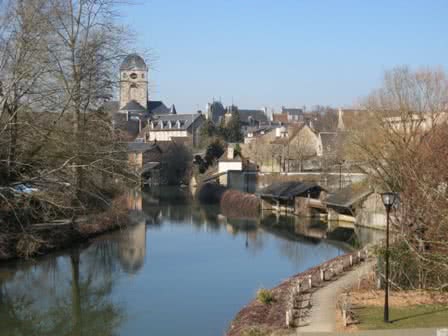







Alençon: World-famous Lace and Birthplace of Saint Theresa of Lisieux
Take a look at "What to See" for sightseeing opportunities (wonderful chateaux, castles, gardens, villages, forests and countryside to explore) and "What to Do" for a sample of the many activities (golf, fishing, walking, cycling, riding, canoeing, climbing) - there really is something for everyone in Lower Normandy and the Pays de Loire.
Alençon Lace
In the 17th century Alençon became famous for its lace called "Point d'Alençon" which is among the finest in the world.
Alençon Lace - see below for detailed technique stages



Alençon Lace Technique
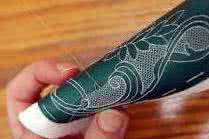
The Alençon lace technique takes 4 years of apprenticeship and about the same again to master it completely. The method of production is extremely labour intensive, taking 7 hours to produce one square centimetre of lace, but it allows for extremely fine and sophisticated designs.
As a luxury item affordable only to the rich - the royal court and aristocracy - Alençon lace production went into decline following the French Revolution, but enjoyed a number of periods of resurgence in the 19th century before going into terminal decline with changes in fashion and introduction of cheap machine-made lace.
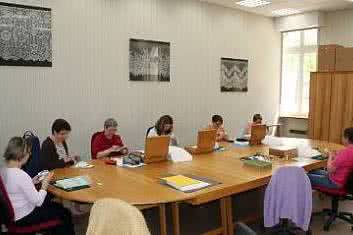
In 1976 the National Alençon Lace Workshop was established to ensure that the Alençon lace-making technique survives into the future.
in 2010 UNESCO recognised the exceptional quality and skill of Alençon lace by adding it to the "Representative List of the Intangible Cultural Heritage of Humanity". In its announcement the UNESCO committee said "Alençon needle lace is unusual because of the high level of craftsmanship required and the very long time that it takes to produce (seven hours per square centimetre)."
The Musée de la Dentelle in the centre of Alençon has a permanent exhibition of lace. The National Lace Workshops are housed in an adjoining building and are open to the public on Mondays, Wednesdays and Fridays in summer. Samples of Alençon lace are for sale in the museum shop but make sure your pockets are deep!
For more information on Alençon lace, including a video of the Alençon Lace Workshops, see our blog article "Alençon Lace - Frilling Stuff".
See below for a description and pictures of the 10 stages involved in the technique Alençon Lace Technique
Alençon to the Middle Ages
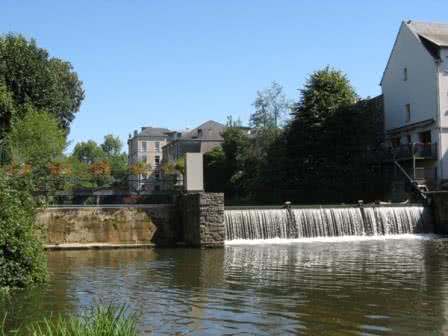
The name Alençon is first seen in a document dating from the 7th century; in gallo-roman times there was an important ford across the Sarthe at this point and Alençon takes its name from the Latin "al unco" meaning "by the hook" or "by the bend" in the river. The ford was located near the old bridge where rue de la Sarthe crosses the river (downstream of Pont Neuf).
During the 10th century Alençon was part of a buffer state between Normandy to the north and the Maine to the south. In 1047 William Duke of Normandy, better later known as William the Conqueror, laid siege to the town. The citizens of Alençon insulted William by hanging animal skins from the walls, in reference to his being the bastard son of Duke Robert and a tanner's daughter. On capturing the town William chopped off the hands of some twenty citizens in revenge - an act he later repeated at Le Mans.
Alençon was later occupied by the English during the Anglo-Norman wars of 1113 to 1203.
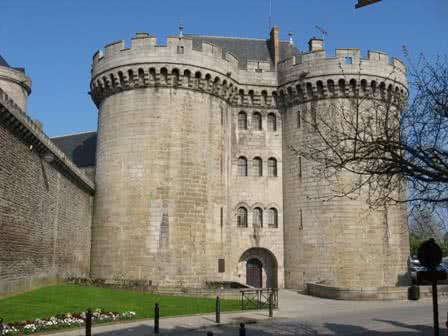
The château of the Dukes d'Alençon once stood in the centre of marshland, which made it difficult to attack. It was largely dismantled over the centuries and the stone reused on other buildings, but the still substantial remains of the château are now preserved as a national monument. Three enormous towers and part of the curtain wall are preserved but the interior is not currently open to the public. During the Second World War the château served as the Gestapo headquarters.
Saint Therese of Lisieux Born in Alençon
Born Marie-Françoise-Thérèse Martin, Saint Thérèse de Lisieux was born in Alençon on January 2, 1873. Also known as Sainte Thérèse de l'Enfant-Jésus et de la Sainte Face, she was a Roman Catholic nun who was canonized as a saint and is recognized as a Doctor of the Church. She is also known by many as "The Little Flower of Jesus."
St. Thérèse was born the daughter of Louis Martin, a watchmaker and jeweller, and Zélie-Marie Guérin, a lacemaker with her own successful business. Both her parents were very religious. Louis had attempted to become a monk, but a lack of knowledge of Latin hindered him. Zélie-Marie had tried to become a nun, but was told she didn't have the vocation. Instead, she vowed that if she married, she would give all her children to the church. Louis and Zélie-Marie met in 1858 and married only three months later. They had nine children, of whom five daughters - Marie, Pauline, Léonie, Céline and their youngest, Thérèse - survived to adulthood; the family, like many at that time, was subject to tuberculosis.
Her mother died of breast cancer in 1877 when Thérèse was only four years old, and her father shortly afterwards moved to Lisieux in the Calvados region of Normandy. There they lived with her maternal uncle Isidore Guérin, a pharmacist, his wife and two daughters.
Shortly thereafter, the bishop reversed his decision and in April of 1889 she became a Carmelite nun at the still tender age of fifteen. More misfortune followed and in 1889 her father suffered a stroke and was taken to a private sanatorium, where he lingered for three years before dying. Upon his death her sister Céline, who had been caring for their father, entered the same Carmelite convent that her three sisters were already in; her cousin, Marie Guérin, also became part of that community. Léonie, after several failed attempts, would eventually become a nun in the Order of the Visitation.
Thérèse became mistress of novices in the convent at the young age of 20. Within the Carmel Therese strove to perfect her "Little Way" of dedicating to God everything she did, no matter how trivial. Therèse told the story in her autobiography, "The Story of a Soul" (L'Histoire d'une Ame).
Sadly, at the age of 22 Therèse contracted tuberculosis. She died on September 30, 1897 at the age of 24. She was canonised by Pope Pius XI in 1925 and is often referred to as the greatest saint of modern times. She is the patroness of the Missions and was declared Doctor of the Church, an honour bestowed upon precious few, by Pope John Paul II on 19 October 1997. Her feast day is October 1st.
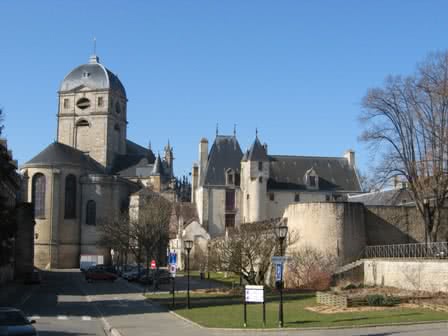
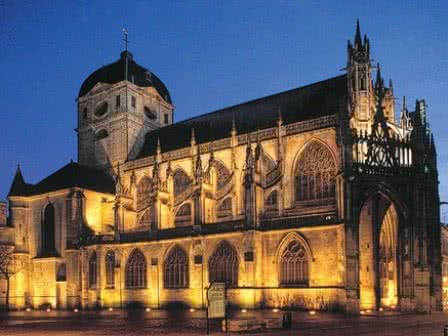
The house and garden in the centre of Alençon where Therèse spent her early years is open to the public and there is a chapel next door. Visits to the house, morning and afternoon, are free - though voluntary donations are welcome to help pay for the upkeep. Other reminders, such as the baptismal font where Therese and her sisters were baptised, can be seen in the family parish church, the Basilica Notre Dame just down the road.
In 2008 the church of Notre Dame became the Basilique de Notre Dame when Therese's parents were both beatified.
Back to top
Alençon in the Second World War WW2
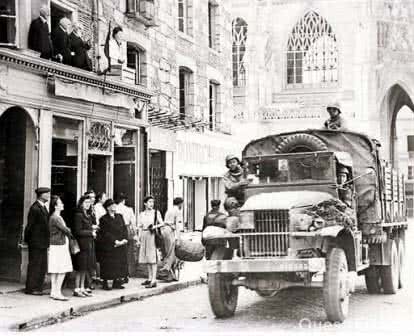
Fierce fighting took place on the outskirts of Alençon in the Forest of Ecouves as the Germans unsuccessfully attempted to prevent the forces of Leclerc from linking with American forces at Argentan. The intention of the Allies was to trap in a pincer movement the retreating German forces, 150,000 strong, who were retreating east from Caen towards Paris through a narrow corridor between Argentan and Falaise.
There is a Sherman tank on display in a clearing in the forest of Ecouves and a memorial to those who died during the battle which took place there as the French forces drove north towards Argentan.
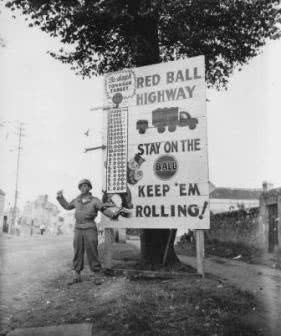
However, the Germans did have to leave most of their equipment behind them in their retreat, along with 50,000 prisoners and 6,000 dead. When General Eisenhower visited the area known as the "Falaise Pocket" and saw it piled high with the bodies of men and animals, and the debris of burnt-out vehicles, he described it as "one of the greatest bloodbaths of the war".
There is an important memorial and military museum at Coudehard, high on the hillside overlooking the valley through which the German forces poured in their retreat and where the final action in the battle of Normandy took place.
Back to top
Alençon Lace Technique
The following is a brief description of the ten stages involved in making traditional Alençon Lace. This is not meant as a didactic guide to learning how to make Alençon lace, which requires an extensive apprenticeship with individual tuition, but to illustrate the general method of Alençon lace making.Alencon lace uses very fine linen thread tightly drawn over a support made of parchment or vellum.
The Craftsmanship of Alençon Needle Lace-making - detailed stages
Alençon lace is inscribed on the UNESCO Cultural Heritage of Humanity list. Alençon Lace Images courtesy and © UNESCO







Ten Stages of Alencon Lace
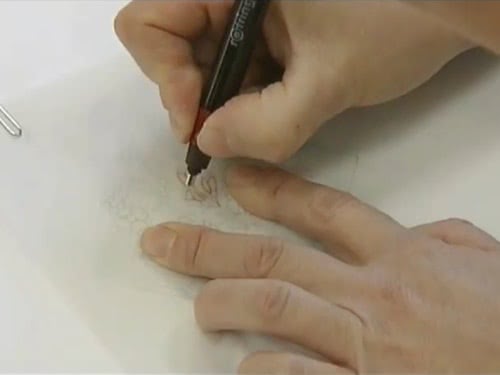
- "Le dessin" or tracing
The design outline is first drawn in ink and then traced onto transparent paper.
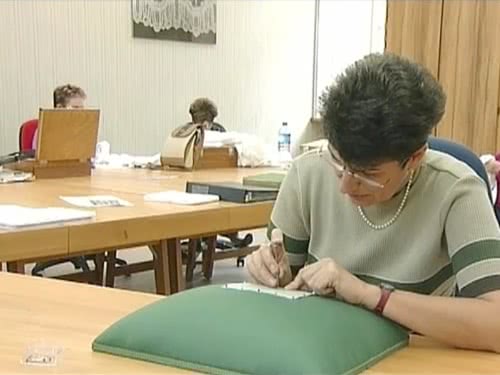
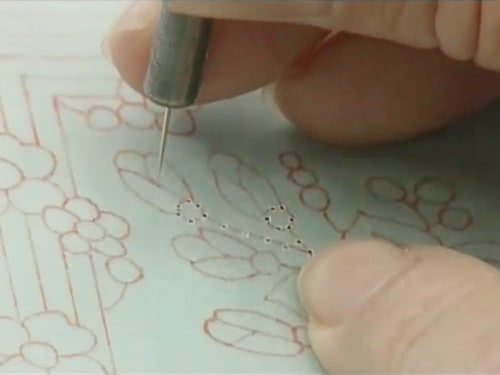
- "Le Piquage" or pin-pricking
The tracing in turn is transferred on to green parchment or vellum (green being less tiring on the eyes) using a 'piquoir', a steel needle mounted on a handle, to pierce the design outline through the transparent paper and the parchment. The parchment and tracing paper are both held firmly in place on a cushion for this stage.
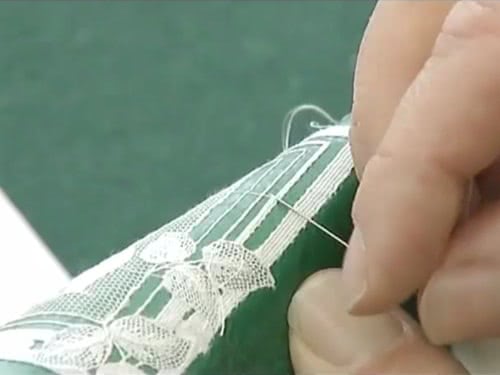
- "La trace" or foundation thread
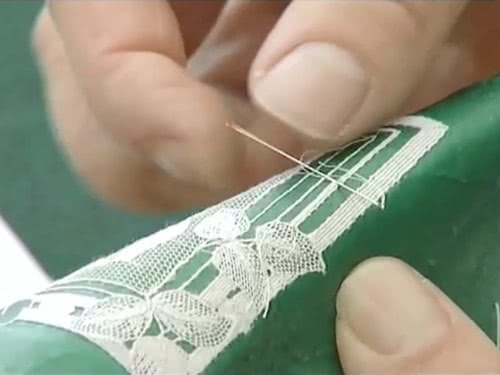
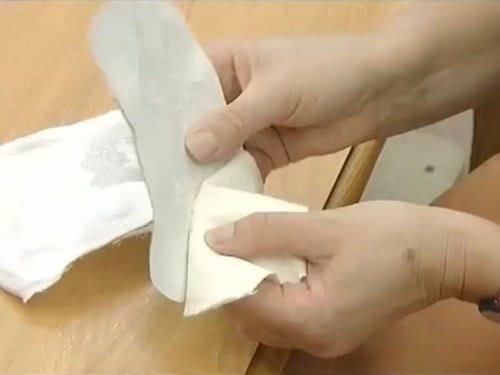
The parchment is placed on a double layer of cloth. The lacemaker lays a foundation thread around the outline of the pattern using a double thread; this double thread follows the outline of the pattern, and is anchored in place by a third thread that passes through the perforations.
This is the only step where needle and thread pierces the parchment. All other stitches are worked over the surface of the parchment and are secured to the foundation thread.
A double layer of cloth is used beneath the parchment so that a razor can be slid between the cloth layers (stage 9) to sever the anchor threads without harming the actual lacework.
- "Le reseau" or background
The background is the open areas that are not part of the actual design motifs, which are filled in at the next stage. The background (or net ground) is an open mesh. A row of double loops is worked between the anchor threads from left to right, bottom to top, working over the surface of the parchment support without piercing it. Once the end of a row is reached, the row of loops is reinforced by passing the thread 3 times around the top or 'dome' of each loop, working back from right to left. This process is repeated until each open background area is filled.
- "Les remplis" or filling stitches
The filling of the design motifs is also made by loop stitches first worked from left to right then reinforced on the return from right to left, but more closely worked than the background. These fill the opaque elements of the of the design proper, flowers, leaves etc.; five different types of loop stitch are used to give variations in light and shade in the finished design.
- "Les modes" or highlights
The 'modes' are characteristic of Alencon lace and there are many different designs that may be used in their execution. Broadly speaking, they are formed by buttonhole stitches (blanket stitches) decorated with scallop stitches or edged with picots (I hope this makes more sense to lacemakers than it does to me!). They are sewn over a horsehair (specifically a forelock hair) which is gradually slid out as the work progresses.
There are some twenty different 'modes' used - jagged patterns, scallop stitches edged with picots, picot-edged ovals, chains of little Xs and so on.
- "La Brode" or relief
The design motifs and the outside edge of the lace are outlined by a very fine relief work called the 'brode' or relief embroidery. This outlining of the motifs is formed by scallop-stitching worked over a supplementary thread to stiffen and give the outlining extra relief.
The scallop stitching on the outer edge of the lace is in turn decorated with picots.
- "Le Levage" or "l'Enlevage" or lifting off
The finished piece of lace is removed from the parchment by sliding a razor between the two layers of cloth and cutting the foundation holding threads. The parchement can then be removed from the backing cloths and the lace gently eased from the parchment.
- "L'Emboutage" or picking off
The lacemaker pulls out all the remaining cut ends of threads with eyebrow tweezers.
- "Le Luchage" or polishing
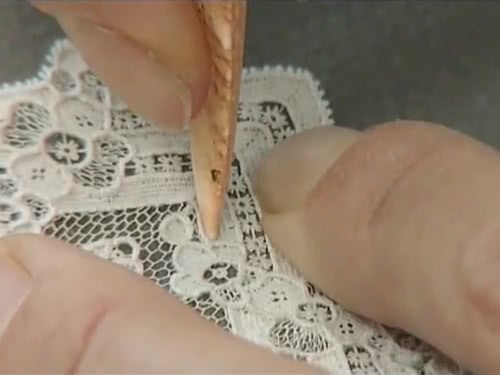
The final stage is a cold-ironing process where the lacemaker polishes the filling stitches ("le Rempli", stage 5) with a lobster claw to accentuate the relief. In former days the same operation was done with a wolf's fang.
A finished section of lace may be sewn up to others to make a larger piece like a flounce or a collar. In order to assemble pieces invisibly, the lacemaker needs to be familiar with all the stages of the lacemaking process. Nowadays lacemakers are taught all of these stages, but when Alencon lace was produced on a large scale from the 17th to 19th century the lacemakers specialised in one particular step and divided the work accordingly. Only the one who finally assembled the pieces knew all the steps.
Back to top